
On this page
Teen Patti (also called 3 Patti or flash) is played with three cards each, and the whole game turns on one question: whose hand is higher? This page gives you the complete rules, the sequence chart from highest to lowest, and something most rules pages leave out: the exact odds of being dealt each hand, calculated from every possible deal, and how often common hands win against one to five opponents. The same rules apply on every table in the Teen Patti Master app.
Teen Patti rules in brief
Every round follows the same steps, whatever the boot amount:
- Boot. Each player puts a fixed amount (or chips) into the pot before the deal.
- Deal. Everyone gets three cards face down from a standard 52-card deck, with no jokers in the classic game.
- Blind or seen. You can bet without looking (blind) or look first (seen). A seen player bets twice what a blind player bets.
- Chaal or pack. On your turn you bet to stay in, or pack and lose what you have already put in. In the app a timer runs on each turn, and it packs for you if the timer runs out.
- Side show. With three or more players left, a seen player can ask the previous seen player to compare hands privately. The weaker hand packs. The other player can refuse.
- Show. With two players left, either can ask for a show. Both hands are revealed and the higher one wins the pot.
The button-by-button walkthrough is in how to play Teen Patti in the Teen Patti Master app. The rest of this page is about which hand beats which, and how often.
Teen Patti sequence chart: highest to lowest
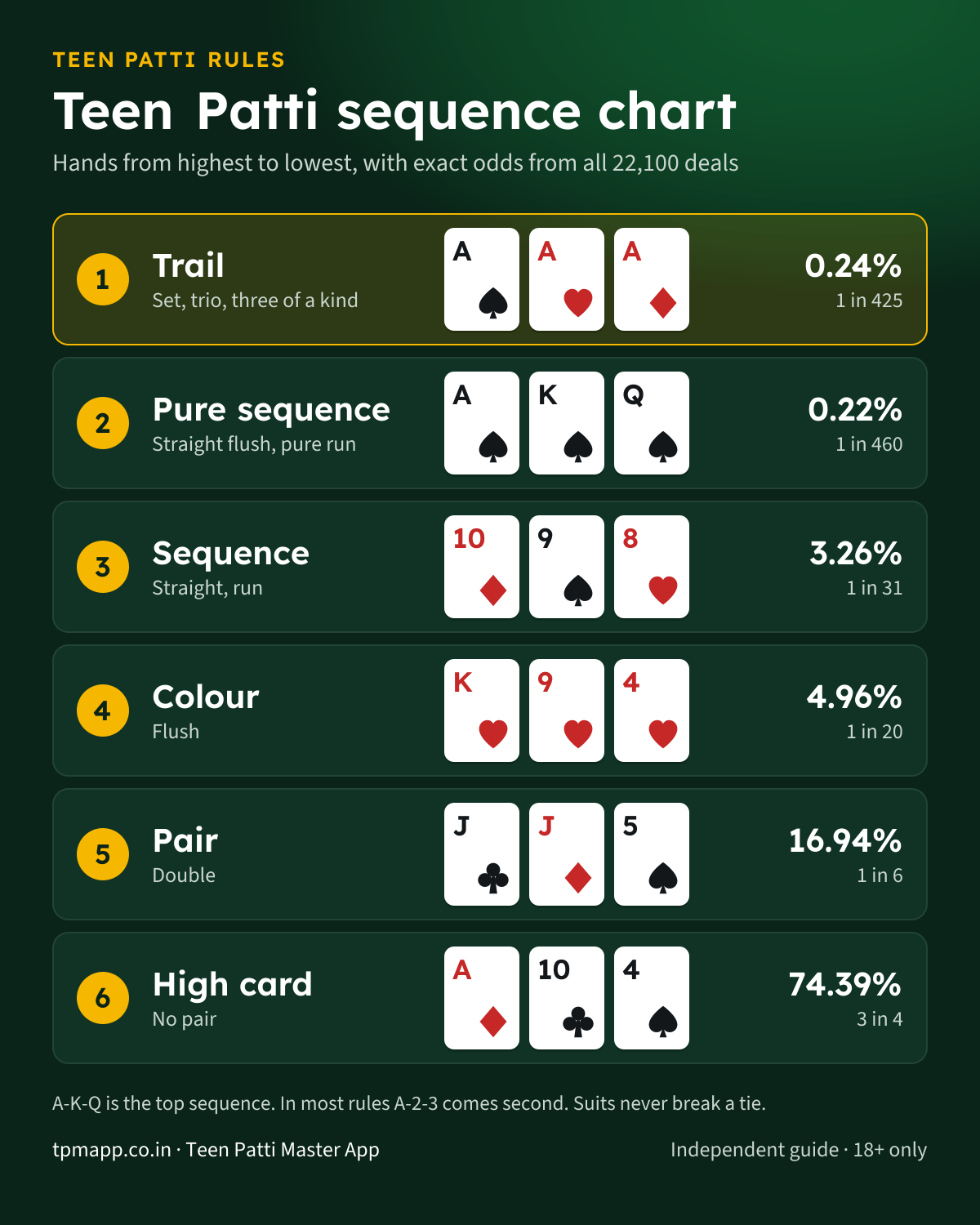
From best to worst:
| Rank | Hand | Also called | Example |
|---|---|---|---|
| 1 | Trail | Set, trio, three of a kind | K♠ K♥ K♦ |
| 2 | Pure sequence | Straight flush, pure run, pakki rung | 8♣ 9♣ 10♣ |
| 3 | Sequence | Straight, run, rung | 3♦ 4♠ 5♥ |
| 4 | Colour | Flush | 2♥ 9♥ Q♥ |
| 5 | Pair | Double | 6♠ 6♦ J♣ |
| 6 | High card | No pair | A♦ 8♣ 4♠ |
Within a rank:
- Trails: A-A-A is the best, 2-2-2 the lowest.
- Sequences: A-K-Q is the best. In most rules A-2-3 comes second, then K-Q-J down to 4-3-2. K-A-2 is not a sequence.
- Colours and high cards: compare the top card, then the second, then the third.
- Pairs: the higher pair wins. With equal pairs, the higher third card wins.
- Suits never break ties in standard Teen Patti.
The same rules are explained in Hindi in our Teen Patti rules in Hindi guide.
Teen Patti sequence list: all 12 sequences
There are 12 three-card runs. This is their order in most rule sets, from highest to lowest:
- A-K-Q (highest)
- A-2-3
- K-Q-J
- Q-J-10
- J-10-9
- 10-9-8
- 9-8-7
- 8-7-6
- 7-6-5
- 6-5-4
- 5-4-3
- 4-3-2 (lowest)
The same order applies to pure sequences, where all three cards share a suit. A wrap-around run such as K-A-2 is not a sequence. Some home games rank A-2-3 as the lowest sequence instead of the second highest, so agree on it before you deal.
What beats what
| Question | Answer |
|---|---|
| Does a trail beat a pure sequence? | Yes. A trail is the highest hand, even though a pure sequence is slightly rarer |
| Does a pure sequence beat a sequence? | Yes. Same run, but all three cards in one suit |
| Does a sequence beat a colour? | Yes. In Teen Patti a run outranks a flush, unlike in poker |
| Does a colour beat a pair? | Yes |
| Does a pair beat a high card? | Yes, any pair beats any high-card hand |
| Is A-2-3 higher than K-Q-J? | Yes, in most rules. A-2-3 is the second-highest sequence |
| Do suits decide a tie? | No. Equal hands stay equal |
High card rules
When nobody has a pair or better, compare the highest card first. Ace is high, then king, queen and down to 2. If the top cards match, compare the second card, then the third. So A-7-4 beats K-Q-9, and K-J-8 beats K-10-9. Suits do not count. If all three cards match in rank, the hands are equal, and in a show most apps give the pot to the player who did not ask for the show.
Teen Patti rules for 2 players
Teen Patti works with two players, and the rules stay the same, with three differences in practice:
- There is no side show. A side show needs three or more players, so with two players left the only way to end the round is a show or a pack.
- The show decides most rounds. In most rules a seen player cannot ask a blind opponent for a show, but a blind player can.
- Weaker hands win more often. Against one opponent a king-high hand wins about 54% of the time, and a pair of 2s wins about 74%. Hands you would pack at a full table are worth playing heads-up.
How often each hand is dealt
There are exactly 22,100 different three-card hands in a 52-card deck. Counting each type gives these exact odds:
| Hand | Number of hands | Probability | Roughly 1 in |
|---|---|---|---|
| Trail | 52 | 0.24% | 425 |
| Pure sequence | 48 | 0.22% | 460 |
| Sequence | 720 | 3.26% | 31 |
| Colour | 1,096 | 4.96% | 20 |
| Pair | 3,744 | 16.94% | 6 |
| High card | 16,440 | 74.39% | 1.3 |
How the counts work
- Trail: 13 ranks, and 4 ways to pick three suits from four. 13 × 4 = 52.
- Pure sequence: 12 possible runs (A-2-3 through Q-K-A) in each of 4 suits. 12 × 4 = 48.
- Sequence: 12 runs × 4 × 4 × 4 suit combinations = 768, minus the 48 pure sequences = 720.
- Colour: 4 suits × 286 ways to choose three cards from 13 = 1,144, minus the 48 pure sequences = 1,096.
- Pair: 13 ranks for the pair × 6 suit pairs × 48 possible third cards = 3,744.
- High card: everything else. 22,100 − 5,660 = 16,440.
A pure sequence is actually rarer than a trail, but the trail ranks higher by tradition, and every app follows that tradition.
How often your hand wins
Knowing that a pair is dealt 17% of the time does not tell you whether to bet on it. What matters is how your hand compares with everyone else's. We simulated 40,000 deals for each hand below against one to five opponents, assuming everyone stays to the end and compares hands. Ties are counted as losses.
| Your hand | Beats this share of all hands | vs 1 | vs 2 | vs 3 | vs 4 | vs 5 |
|---|---|---|---|---|---|---|
| Q-high (Q 10 7) | 39% | 39% | 15% | 5% | 2% | 1% |
| K-high (K J 8) | 54% | 54% | 28% | 14% | 7% | 4% |
| A-high (A K 9) | 74% | 74% | 55% | 41% | 30% | 23% |
| Pair of 2s | 75% | 74% | 55% | 41% | 30% | 23% |
| Pair of 7s | 81% | 81% | 66% | 53% | 43% | 35% |
| Pair of 10s | 85% | 85% | 73% | 62% | 53% | 45% |
| Pair of aces | 90% | 91% | 83% | 76% | 69% | 63% |
| Low colour (7 4 2) | 92% | 91% | 84% | 76% | 70% | 63% |
| Ace-high colour (A 9 5) | 96% | 96% | 92% | 87% | 84% | 80% |
| Lowest sequence (4 3 2) | 96% | 96% | 92% | 89% | 86% | 82% |
| A-K-Q sequence | 99% | 99% | 99% | 98% | 98% | 97% |
Percentages are rounded to whole numbers. Assumptions: Classic rules, A-2-3 as the second-highest sequence, no jokers, and nobody packing. Real tables differ because players pack, but the pattern holds. The A-K-9 and pair-of-2s rows look identical after rounding, and that is a real result: before rounding they came out at 74.1, 54.6, 40.8, 29.8 and 22.6% for A-K-9 against 73.9, 55.0, 40.9, 30.1 and 22.7% for the pair of 2s. A pair of 2s only just outranks the best high-card hands, so the two perform almost the same.
What the numbers teach
High cards lose value fast
A king-high hand beats more than half of all hands, so it feels decent. Against four opponents who stay in, it wins only about 7% of the time. If you hold king-high or worse at a full table and someone is betting seen, packing is almost always right.
A small pair is about as strong as ace-high
A pair of twos and A-K-9 win almost equally often. Many players overvalue any pair. Low pairs are good hands heads-up, and much weaker when several players are left.
Colour and sequence are strong at any table
Even the lowest colour wins about two times in three against five opponents. A sequence of any kind wins more than four times in five. These hands justify steady betting.
Table size changes everything
The same hand can be a clear bet heads-up and a clear pack at a full table. Before each decision, count how many players are still in. Our Teen Patti card game strategy guide turns these numbers into ten practical tips.
Odds in the variations
- Joker and AK47: wild cards make trails, sequences and colours far more common. A pair that is strong in Classic can be weak in a joker game.
- Muflis: the rankings flip, so the lowest high-card hand (2-3-5 of mixed suits) is the best, and trails become the worst hands.
- Four-card (best of four): with four cards to choose from, everyone's best three-card hand improves, so raise the bar for what counts as strong.
More on each game in our Teen Patti Master games and variations guide.
A note on luck and money
Good decisions improve your results over thousands of hands. In a single session, luck dominates. A player with a perfect strategy can still lose many hands in a row. This is why card games played for money are risky, and why online money games are now banned across India under the Promotion and Regulation of Online Gaming Act, 2025. Use these odds to play free-chip tables better, not to chase losses.
To practise on free-chip tables, the current build of the app is v34.65 (63.8 MB, Android 5.0 or newer). Specs, install steps and the version selector are on Teen Patti Master 2026.
Frequently asked questions
What is the Teen Patti sequence from highest to lowest?
Trail (three of a kind), pure sequence, sequence, colour, pair, and high card last. Within sequences, A-K-Q is the highest, A-2-3 is second in most rules, and 4-3-2 is the lowest.
What is the best hand in Teen Patti?
A trail of three aces (A-A-A). The best pure sequence, A-K-Q of one suit, comes next.
Is A-2-3 the highest sequence in Teen Patti?
No. A-K-Q is the highest. In most rules A-2-3 is the second-highest sequence. Some home games and apps treat it as the lowest, so check the table rules.
Which is rarer, a trail or a pure sequence?
A pure sequence is slightly rarer: 48 possible hands against 52 for a trail. The trail still ranks higher by tradition.
Does a sequence beat a colour in Teen Patti?
Yes. A sequence (three cards in a row) ranks above a colour (three cards of one suit). This is the opposite of poker, where a flush beats a straight.
What are the chances of getting a pair in Teen Patti?
About 16.9%, or roughly one hand in six.
How often will I get a high card hand?
About 74% of the time, or three hands out of four.
Can two players play Teen Patti?
Yes. The rules and rankings are the same, but there is no side show, and hands are stronger heads-up: a king-high hand wins about 54% of the time against one opponent.
Do suits matter in Teen Patti?
No. In standard Teen Patti, suits only matter for making a colour or pure sequence. They are never used to break a tie.
How were the win rates calculated?
The dealing odds are exact counts over all 22,100 possible hands. The win rates come from 40,000 random deals per hand and opponent count, with every player staying to the end and ties counted as losses.